Address
doha Imm E4 Res guilize 3éme TR, Marrakech-Medina - Maroc

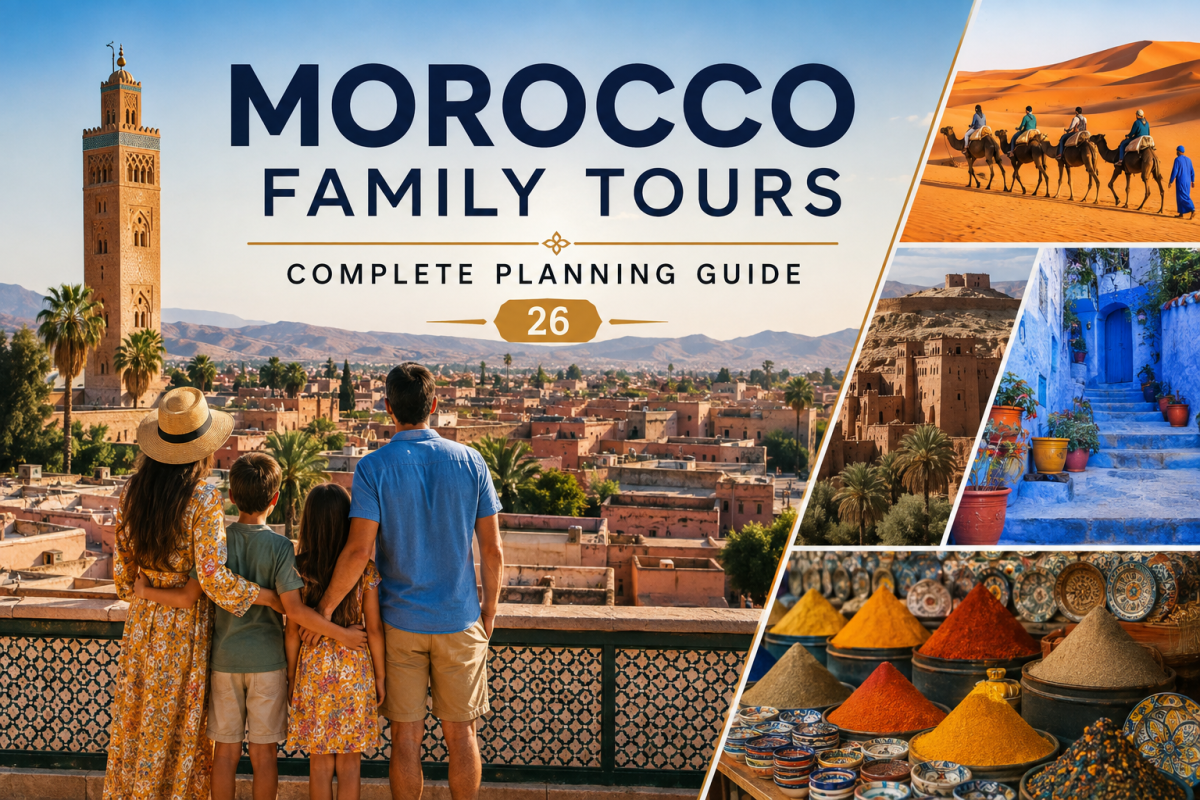
Morocco Family Tours: Complete Planning Guide-26
Morocco Tours for Families: How to Plan an Adventure That Works for Every Generation
Morocco Tours can give families several very different experiences within one journey: historic medinas in Fes, the Sahara Desert, kasbahs around Ouarzazate, the energy of Marrakech, Moroccan food, traditional crafts, and opportunities for meaningful cultural exchange.
For families, however, an exciting itinerary on paper is only half the decision. Parents and multigenerational groups also need to understand how demanding the trip will be, how much time is spent moving between destinations, which Activities work for different ages, what a desert experience involves, and whether dietary, accommodation, and mobility needs can be accommodated.
That distinction matters. A camel ride may be a highlight for one traveler and unsuitable for another. A fascinating medina can involve substantial walking. A luxury desert stay may sound appealing, but families still need to verify the actual facilities and sleeping arrangements.
A well-planned family trip to Morocco should therefore balance culture and adventure with realistic pacing, suitable accommodations, flexible activities, good guides, and clear expectations. The same applies when comparing longer itineraries, Day Trips, desert tours, or Activities From Marrakech: the best option is the one that fits the people actually traveling.
Is a Morocco Tour Right for Your Family?
Morocco is particularly appealing to families who want a trip built around experiences rather than a conventional resort holiday. The combination of cities, desert landscapes, food, architecture, markets, crafts, and cultural encounters can give different generations different ways to engage with the same destination.
That does not make every itinerary appropriate for every family.
The most useful question is not simply, “Is Morocco family-friendly?” It is, “Does this particular itinerary fit the ages, mobility, interests, dietary requirements, and travel style of our family?”
Before choosing a tour, look at five factors together:
- Age suitability and any minimum-age requirements for individual activities
- Amount of walking and the surfaces encountered
- Time spent traveling between destinations
- Flexibility for anyone who wants to skip an activity
- Accommodation and room arrangements, particularly in desert locations
This becomes even more important on a multigenerational trip. A young child, a teenager, a parent, and a grandparent may all enjoy Morocco, but they will not necessarily want to experience it at the same pace.
Traveling with children
Children who enjoy exploring, trying new experiences, seeing animals, learning how things are made, or encountering unfamiliar foods may find plenty to engage with. A family itinerary could combine sensory experiences in Fes with crafts, Moroccan cuisine, desert activities, and time at accommodations where everyone can relax.
Parents should look beyond activity names, however. Ask how long each experience lasts, how much walking it entails, how breaks are handled, and whether an alternative is available if a child becomes tired or does not want to participate.
Traveling with teenagers
Teenagers may appreciate an itinerary that goes beyond passive sightseeing. Camel rides, desert stays, artisan visits, food experiences, and interactions with local people can provide more active ways to connect with Morocco.
Adventure options are another possibility around Marrakech. Quad biking, buggy trips, camel rides, and hot-air-balloon experiences may be marketed to visitors, but families should never infer age eligibility or suitability from the activity name alone. Confirm current restrictions, safety arrangements, required equipment, supervision, and insurance conditions directly with the provider.
Cultural exchange can also be meaningful when it is more than a staged photo opportunity. If an itinerary includes a school, home, or community visit, it is reasonable to ask how the interaction is organized and how the host community participates in and benefits from it.
Traveling with grandparents
A multigenerational Morocco trip can create shared experiences without requiring every person to do exactly the same thing. That flexibility is important.
Older travelers should establish the walking demands, vehicle access, stairs, terrain, camel-riding requirements, and accommodation accessibility before booking. A claim that a tour suits multiple generations is useful only when the practical itinerary supports it.
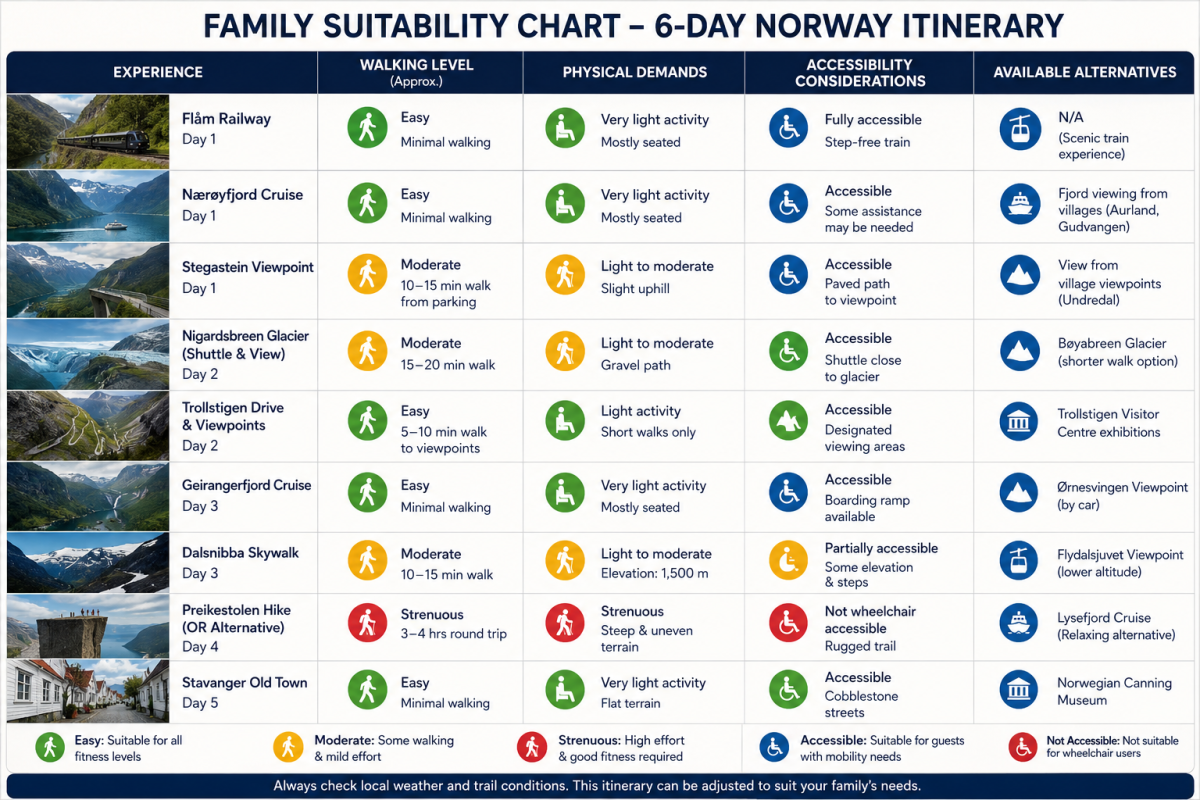
Morocco Family Tours at a Glance
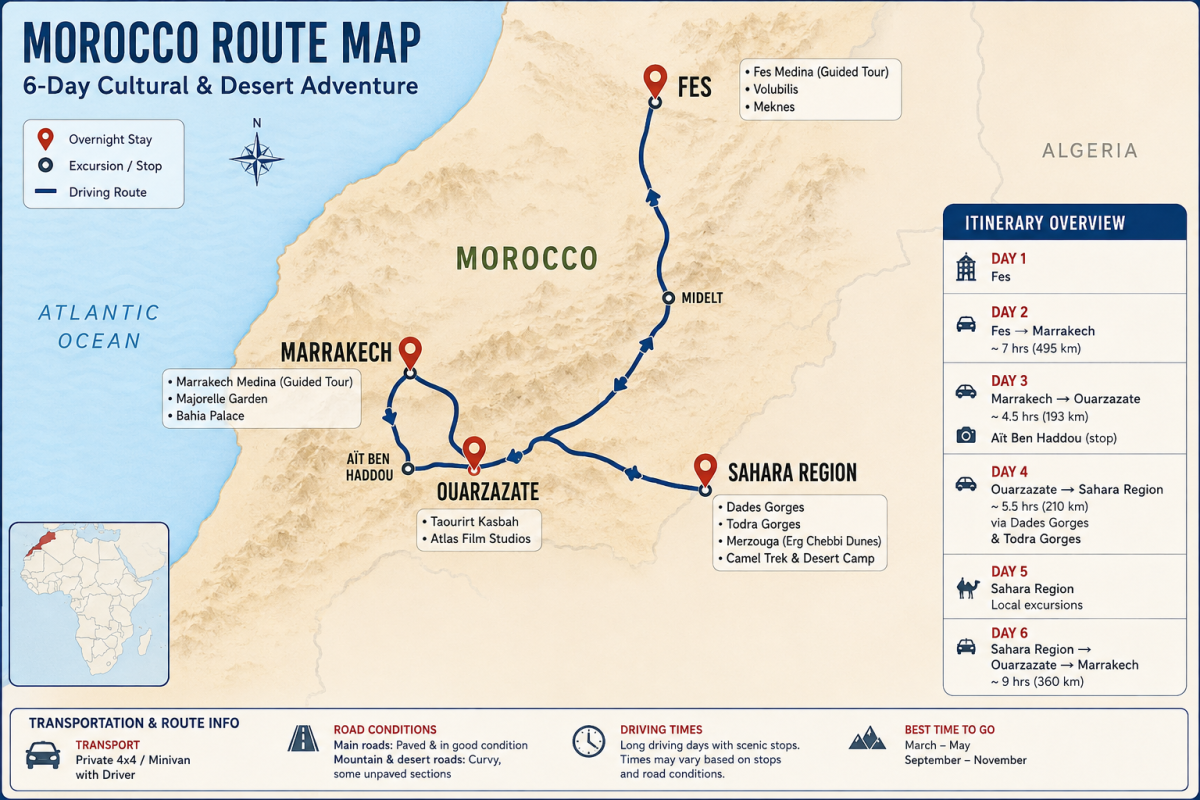
An itinerary incorporating Fes, the Sahara Desert, Ouarzazate, and Marrakech gives travelers access to several distinct sides of Morocco.
Fes provides medinas, souks, traditional crafts, and the atmosphere of a historic city. The Sahara changes the setting completely, with dunes, camel experiences, sunset, and desert accommodations. Ouarzazate introduces kasbah architecture and connections with filmmaking. Marrakech can serve both as a destination in its own right and as a base for excursions into surrounding areas.
The variety is one of the route’s attractions, but it also creates a logistical consideration: these experiences do not happen in one place.
Families should inspect the daily itinerary rather than judging a tour solely by its highlights. Find out which days involve substantial transfers, when activities occur after travel, how much free time is available, and whether an itinerary leaves enough space to rest.
A trip can contain excellent individual experiences and still be too demanding if they are packed too tightly together.
Different tour formats also solve different travel needs. Morocco Imperial Cities itineraries emphasize city-based exploration, while a desert-focused itinerary places more weight on the journey to and experience of desert landscapes. Shorter Excursions From Marrakech can make sense when a family prefers to keep one accommodation base for more of the holiday.
Family Experiences in Fes, the Sahara, Ouarzazate, and Marrakech
Exploring Fes as a family
Fes offers families a direct introduction to the medina, souks, crafts, textiles, spices, and traditional artisan work associated with the city. It can be especially rewarding when children have something specific to look for or learn rather than simply following adults through a sightseeing route.
Traditional leather work and other crafts can turn an abstract lesson about Moroccan culture into something visible. Watching how an object is produced often gives younger travelers a clearer point of connection than hearing a long explanation.
The practical side deserves equal attention. Families should ask how much walking the planned Fes visit involves, where breaks occur, and what the experience is likely to demand from younger children or relatives with limited mobility.
A knowledgeable guide can make a substantial difference. The value of guiding is not merely navigation. An effective family guide should explain what travelers are seeing at different levels of complexity, recognize when attention is fading, and make room for questions and hands-on learning where appropriate.
Experiencing the Sahara Desert
The Sahara is likely to be one of the most anticipated parts of a family adventure. The change in landscape can give the journey a completely different character from Morocco’s cities.
A desert itinerary may combine camel riding, dunes, sunset, and overnight accommodation. These elements can be memorable, but they also generate some of the most important planning questions.
Families researching short desert itineraries may encounter products described as 2 Days private Zagora Desert, Zagora 2 Days Desert Tour, 3-Days private from Marrakech to Merzouga Desert, or 3 Days To Merzouga desert. These names should be treated as product or itinerary descriptions rather than interchangeable experiences.
The duration alone does not tell you how the trip feels. Compare the actual route, transfer schedule, accommodation, meals, stops, camel activity, private versus shared arrangements, and time available at the destination. For families, the amount and structure of road travel can be as important as whether an itinerary is labeled two or three days.
Before departure, establish what the particular tour means by a camel ride. Ask about its duration, physical requirements, supervision, and any restrictions relevant to your family.
Most importantly, ask what alternative is provided for someone who does not want to ride.
A family experience should not depend on every traveler having the same level of comfort with every activity. Alternative arrangements may matter for children, grandparents, travelers with mobility concerns, or simply anyone who prefers not to participate.
What to check about desert accommodation
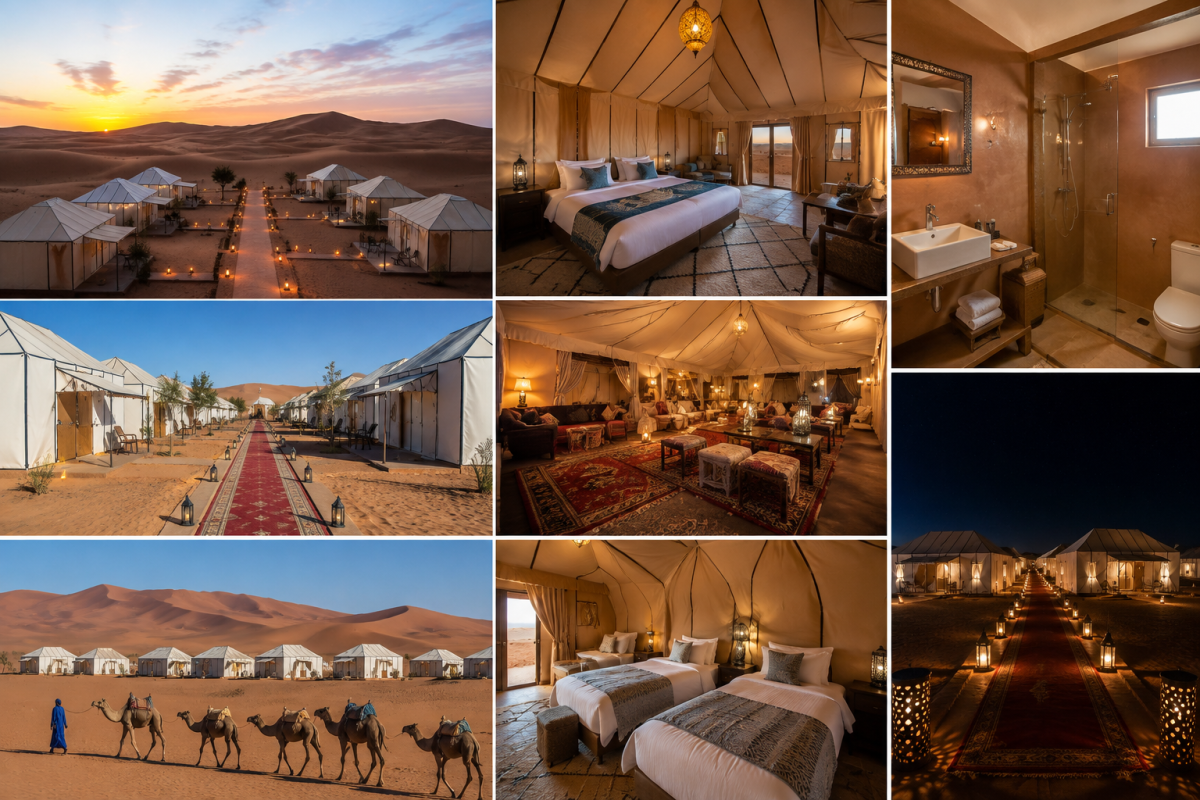
“Luxury desert camp” can describe an accommodation’s positioning, but the word luxury does not tell a family everything it needs to know.
Before booking, verify the actual facilities for your departure. Useful questions include whether bathrooms are private or shared, how family members are accommodated, what bedding is provided, which amenities are available, and what arrangements exist for anyone with mobility requirements.
Desert environments also make packing and comfort planning important. Rather than relying on generalized assumptions, obtain current guidance for the season, destination, and itinerary of your departure.
Ouarzazate and Morocco’s kasbahs
Ouarzazate gives travelers a different focus, combining kasbah architecture with associations with film production. That creates more than one way for family members to engage with the destination. One person may be interested in architecture and cultural context while another is drawn to its filmmaking connections.
The same destination can also appear within different types of itineraries. A family based in Marrakech, for example, may encounter a product described as a Day Trip to Ouarzazate – Ait Benhaddou, while a longer Morocco itinerary may incorporate the Ouarzazate area as part of a broader route.
Those options should not be treated as equivalent solely because they mention the same destination. Compare how much of the day involves transportation, which locations are actually included, the amount of walking required, and whether the pace suits your family.
A detailed itinerary should identify the places being visited rather than relying on broad promises. This allows parents to understand the day’s activities and investigate accessibility where necessary.
Marrakech with children and a multigenerational group
Marrakech can operate as both a major stop on a Morocco tour and a base for shorter adventures.
For families, “visiting Marrakech” is not enough to establish suitability. The useful details are the scheduled experiences, amount of walking, guide support, available free time, and overall pace.
For younger travelers, giving a city visit a purpose can make it more engaging. Crafts, food, architecture, or a specific hands-on activity can provide a focal point. Adults may value the historical and cultural interpretation a knowledgeable guide can provide.
Marrakech also presents a useful planning choice: spend more time exploring the city or use some of that time for nearby activities and excursions. Families do not necessarily need to maximize both. A child who is already tired after several days of touring may benefit more from free time than another full-day excursion.
Day Trips and Excursions From Marrakech
Families using Marrakech as a base may find a broad selection of Day Trips and adventure experiences. The key is to distinguish between a destination excursion and a shorter recreational activity.
Destination-oriented options may be marketed as a Day Trip to Ourika Valley, Day Trip to The Three Valleys, Day Trip to Ouzoud Waterfalls, Day Trip From Marrakech to Essaouira, or Day Trip to Ouarzazate – Ait Benhaddou. These represent different places and should be evaluated on their individual itinerary rather than grouped together as equivalent “things to do.”
For each excursion, compare:
- Departure and return arrangements
- Transportation included in the product
- Amount of time spent traveling versus exploring
- Walking and physical demands
- Meals or other inclusions
- Accessibility considerations
- Age or participation restrictions, where applicable
- Cancellation and weather-related policies
Do not choose a Day Trip to Ourika Valley, Day Trip to The Three Valleys, Day Trip to Ouzoud Waterfalls, or Day Trip From Marrakech to Essaouira simply because the destination name is appealing. For a family, the structure of the day matters at least as much as the headline location.
Likewise, Ouarzazate can make sense within some itineraries but should be evaluated according to the actual route and schedule. The purpose of comparing Excursions From Marrakech is not to collect as many destinations as possible. It is to identify which experience adds something worthwhile to the trip without making the overall itinerary unnecessarily exhausting.
Adventure Activities From Marrakech
Families looking for more active experiences may also see products marketed as Buggy Adventure in Agafay Desert, Quad Biking in Agafay Desert, Buggy Adventure in Palmeraie, Quad Ride Palmeraie Marrakech, or Hot Air Balloon in Marrakech.
These are very different from guided city sightseeing or a destination day trip, so they require a different booking checklist.
For motorized or adventure Activities From Marrakech, verify current age and participation requirements, operator safety procedures, protective equipment, supervision, passenger arrangements, and what the booking includes. Do not assume an activity is child-friendly merely because family bookings are accepted.
The setting also matters. Agafay desert activities and experiences in Palmeraie Marrakech should not be confused with a multi-day trip to the Sahara. They may provide an accessible adventure from Marrakech, but they are distinct experiences in different locations.
That distinction is particularly important when comparing photographs and product titles online. A short activity outside Marrakech cannot be evaluated as a substitute for a Sahara itinerary without considering what your family actually wants from the experience.
Camel rides around Marrakech
Families who want a camel experience without building a multi-day desert itinerary into their holiday may encounter options such as Camel ride in the Palmeraie or a Sunset camel ride Marrakech experience.
Again, the product name is only a starting point.
Marrakech Palmeraie experiences should be evaluated according to their actual location, duration, transportation arrangements, participation requirements, and operator. A camel ride near Marrakech and a camel experience during a Sahara journey offer different contexts.
Travelers researching Camel ride Marrakech price / cost should also compare what is included rather than focusing on the advertised amount alone. Prices can vary by provider, date, private or shared format, transfer arrangements, duration, and other inclusions. Current pricing should therefore be confirmed directly for the specific product under consideration.
The same applies when comparing a Camel Ride at sunset in Agafay with a Sunset camel ride Marrakech product elsewhere. Check the exact location before booking; “Marrakech” in a product name does not necessarily mean the experience occurs in the city itself.
Cultural Experiences That Go Beyond Sightseeing
Family travel can be educational without feeling like a classroom lesson. Morocco’s craft traditions, cuisine, architecture, and opportunities for interaction can help younger travelers understand a destination through people and processes rather than a sequence of landmarks.
Meeting artisans and seeing traditional crafts
Watching a craftsperson work gives families an immediate question to explore: How was this made?
In Fes, an itinerary may include traditional leather work. Elsewhere, families may encounter rug weaving and other artisanal traditions. These experiences can provide a useful connection between objects seen in markets and the skill involved in producing them.
A good guide should add context rather than treating an artisan simply as entertainment. Families benefit from learning what they are looking at and how to engage respectfully.
Understanding Amazigh and Berber people in cultural encounters
Travel material frequently uses “Berber people” when referring to Indigenous North African communities and traditions; “Amazigh” is also widely used. Families benefit from recognizing both terms while avoiding the assumption that a broad cultural identity represents one uniform community or way of life.
Where a tour includes a meal or encounter with an Amazigh family or community, the experience should be explained carefully rather than reduced to a tourism label.
Sharing food in a home can be meaningful because it moves an itinerary away from conventional sightseeing. Travelers should still be able to understand how the visit is arranged, who hosts the experience, and how participation is organized respectfully.
School and community visits
An opportunity for children to meet young people from another country can encourage curiosity and make cultural differences and similarities more immediate.
School visits also require particular care. Children in the host community are not tourist attractions.
If a tour incorporates a school visit, parents can reasonably ask how permission and safeguarding are handled, what the purpose of the exchange is, and how the relationship benefits the school or community rather than existing solely for visitors.
Those answers are more useful indicators of responsible travel than broad claims about authenticity.
Moroccan Food and Family Dietary Needs
Food can be both a highlight and a source of uncertainty on a family trip. Moroccan dishes such as tagine, couscous, and breads provide an approachable starting point for exploring local cuisine, while preferences may differ widely within the same family.
The key is not to promise that every traveler will like everything. It is to establish how much flexibility exists.
Before booking, families with particular dietary requirements should communicate them clearly and ask how they will be handled throughout the itinerary, including during desert stays, Day Trips, and any meals in private or community settings.
This is particularly important for medical dietary restrictions and allergies. A general statement that dietary needs can be accommodated is not the same as confirmation that a specific requirement can be managed safely at every location.
Families with selective eaters can also benefit from knowing what alternatives are normally available. That makes it easier to encourage children to try unfamiliar dishes without making every meal a test.
What Family-Friendly Accommodation Should Mean in Practice
A beautiful hotel is not automatically a convenient family hotel.
Adults may value views, attractive surroundings, and opportunities to relax. Children may care more about a pool or room setup. A grandparent may prioritize straightforward access and comfort. Families booking multiple rooms may care most about whether those rooms can be arranged appropriately.
That is why “family-friendly” should be treated as a set of practical characteristics rather than a marketing category.
Before confirming accommodation, determine which details matter to your group:
- Family occupancy and room configuration
- Whether connecting or nearby rooms can be requested
- Pool availability where relevant
- Accessibility for family members with mobility limitations
- Bathroom arrangements, particularly at desert camps
- Meal flexibility
- How much movement is required between rooms and common areas
Not every family needs every feature. Identify your non-negotiables before booking rather than discovering them during the trip.
Accommodation also affects itinerary pacing. A well-designed family journey should leave people some opportunity to enjoy where they are staying instead of using every hotel solely as a place to sleep before another early departure.
Getting Around Morocco as a Family
Transportation is one of the least glamorous parts of travel planning and one of the most important for family comfort.
An itinerary connecting Fes, the Sahara, Ouarzazate, and Marrakech necessarily involves traveling between different locations. Exact times and arrangements depend on the itinerary and provider, so they should be verified rather than assumed.
Ask for the complete daily schedule and look at transportation as part of the experience, not blank space between attractions.
For each significant transfer, establish:
- The planned mode of transport
- How the travel day is structured
- How breaks are handled
- What activity is scheduled before or after the transfer
- Whether luggage requires special handling
- What flexibility exists if a family member becomes tired
This information is particularly important for younger children and older travelers.
A long transfer is not necessarily a reason to reject an itinerary. The more relevant issue is whether travel is acknowledged and sensibly integrated into the day’s pace.
Airport transfers and arrival planning
Airport transfers deserve the same scrutiny as sightseeing transportation, especially when a family arrives with children, several bags, or multiple generations.
Before departure, verify where the transfer begins and ends, how the family meets the driver, what vehicle arrangements apply to the group, and whether any child-specific requirements need to be requested in advance.
Do not assume Airport transfers are included merely because other transportation appears in the tour package. Confirm their status explicitly for the booking.
When Is the Best Time for a Morocco Family Trip?
The best time for your family depends on the places included in the itinerary, the Activities planned, and the conditions your travelers handle comfortably.
A route combining cities and desert environments needs more nuanced planning than choosing dates based on a single destination. Conditions can affect packing, comfort, walking, and outdoor experiences.
Because conditions vary by location, season, and travel dates, families should check current reliable guidance rather than rely on a generalized claim that one period is universally “best.”
When comparing departures, ask:
- What conditions should we expect at each destination?
- What should the family prepare for during desert days and nights?
- Could the expected conditions affect walking or outdoor activities?
- Does the operator recommend particular clothing or equipment?
- Are any itinerary elements seasonal or weather-dependent?
Families limited by school holidays may have fewer choices. In that case, the aim is not to find a theoretically perfect month but to understand the trade-offs associated with the dates available.
This is particularly relevant to weather-sensitive experiences such as a Hot Air Balloon in Marrakech or certain outdoor adventure activities. Current operating decisions and cancellation policies should always come from the provider rather than an undated travel guide.
Family Safety, Health, and Practical Preparation
Useful family travel planning should avoid two extremes: treating ordinary travel as inherently dangerous or dismissing reasonable concerns with vague assurances that everything will be fine.
Specific circumstances matter.
Before traveling, families should obtain current official guidance relevant to entry requirements, health considerations, and any other travel rules that apply to their nationality and dates. These details can change.
Prepare for the itinerary you are actually taking
Packing advice becomes more useful when it starts with the schedule. A journey that includes medina walking, a desert stay, hotels, cultural visits, Day Trips, and different Moroccan cities creates several contexts rather than one.
Review the itinerary and identify:
- Clothing and footwear appropriate to scheduled activities
- What is needed for any desert overnight
- Personal medication and essential health items
- What children need during transfer days
- Items required for specific dietary or medical needs
- Comfortable options for periods of walking
Avoid packing based purely on destination photographs. Ask the operator what is genuinely necessary for your departure.
Think about medina sightseeing practically
Historic medinas can be culturally rich environments, and family members may respond differently to a busy, unfamiliar setting. Establish meeting expectations before entering crowded areas and make sure children know whom they should stay with.
Guided sightseeing can reduce the navigation burden and give the environment context. It does not eliminate the need for ordinary family awareness and preparation.
Discuss medical and dietary requirements before departure
If a traveler has a medical condition, mobility requirement, severe allergy, or other need that could affect participation, disclose it while evaluating the trip rather than after arrival.
Ask how the particular requirement affects the actual itinerary and whether alternatives are limited at any stage.
For matters requiring medical advice, travelers should consult an appropriate healthcare professional rather than relying on general destination content.
Why Guides Matter on a Multigenerational Morocco Tour
A family guide does more than explain what a group is looking at.
Different generations process a destination in different ways. Younger children may need stories, interaction, and shorter explanations. Teenagers may engage better through questions and activities than lectures. Adults may want more cultural context. Older travelers may appreciate a pace that leaves enough time to observe rather than rush.
A good guide can connect those needs.
When evaluating Morocco Tours, useful questions include how much experience guides have with families, how they adapt explanations for different ages, which languages they guide in, and how much flexibility they have when a group’s needs change.
Local knowledge is valuable, but ancestry or identity alone should not substitute for professional information. Guide experience, communication skills, destination knowledge, and the ability to manage a multigenerational group are more useful decision factors.
What to Clarify Before Booking Morocco Tours
The headline experiences tell you what makes a trip exciting. The booking details tell you whether it will work.
Before committing, compare the complete itinerary with the needs of every traveler. Do not assume something is included, private, flexible, accessible, or suitable for children unless the current product information confirms it.
A practical pre-booking check should cover:
- Confirm age and participation requirements. This is particularly important for camel rides, quad biking, buggy experiences, balloon flights, and other adventure activities.
- Review physical demands. Establish expected walking, terrain, stairs, and requirements for desert portions of the itinerary.
- Examine transfer days. Understand how the family moves between destinations and how much activity is planned on the same days.
- Ask about alternatives. Find out what happens when someone cannot or does not want to participate.
- Verify accommodation. Confirm room configuration and any facilities important to your family.
- Check desert arrangements. Ask about sleeping arrangements, bathrooms, amenities, and how accommodation is reached.
- Discuss dietary needs. Separate general preferences from medical restrictions and obtain appropriate confirmation.
- Understand inclusions. Check meals, Activities, transportation, Airport transfers, accommodation, guides, and items requiring separate payment.
- Compare activity locations. Marrakech Palmeraie, Agafay, and the Sahara are not interchangeable simply because similar activities may be offered in each.
- Verify current travel information. Entry rules, prices, operating arrangements, accommodation, and other trip details can change.
This due diligence does not make a holiday less spontaneous. It reduces preventable uncertainty so families can enjoy the experiences they chose.
Common Mistakes When Choosing a Morocco Family Itinerary
One common mistake is choosing entirely from photographs and activity highlights. Dunes, medinas, pools, waterfalls, balloon flights, and kasbahs can all look compelling, but photographs rarely explain transfer time or physical demands.
Another is assuming “family-friendly” means suitable for every age. The phrase is too broad to make that decision. The actual itinerary matters more.
It is also easy to overschedule Marrakech. Travelers may see a long list that includes Quad Biking in Agafay Desert, Camel ride in the Palmeraie, Hot Air Balloon in Marrakech, and multiple Day Trips and feel pressure to fit several into a short stay. More Activities do not automatically create a better family trip.
Families should also avoid treating cultural encounters as performances arranged solely for visitors. Experiences involving craftspeople, schools, homes, Berber people or Amazigh communities become more meaningful when travelers understand the context and engage respectfully.
Finally, do not wait until the journey begins to mention a mobility need, significant dietary restriction, or activity concern. Those questions are most useful before booking, when the itinerary can still be assessed properly.
Organized Morocco Tours, Day Trips, or Independent Travel?
These travel formats solve different problems.
An organized multi-day tour can appeal to families that want someone else to coordinate a route, accommodations, guides, and planned experiences. That can be particularly helpful on a journey incorporating several destinations.
Day Trips and Excursions From Marrakech allow travelers to retain a base while adding selected experiences. They can reduce the need to change hotels, although each excursion still needs to be evaluated for transportation and pacing.
Independent travel gives families more control over their schedule but places more responsibility on them for researching transportation, accommodation, Activities, guides, and current practical requirements.
None is automatically better.
An organized tour may be more appealing when the family prioritizes logistical support, guided interpretation, and a coherent multi-stop itinerary. Day trips may fit travelers who want a stable base with selective exploration. Independent planning may suit families whose highest priority is control over the schedule.
The meaningful comparison is how much planning control your family wants versus how much logistical responsibility it wants to carry.
Who May Need a More Flexible Morocco Itinerary?
No itinerary is universal.
Families may need additional flexibility when a traveler has limited mobility, when a young child needs substantial downtime, when someone has a significant dietary or medical requirement, or when family members differ sharply in their tolerance for travel days.
The same applies to activity preferences. If a desert itinerary centers on camel riding but one traveler does not want to participate, the existence and quality of an alternative matter. If most city sightseeing involves walking, accessibility becomes a core booking question rather than a minor detail.
Families that prefer considerable unscheduled time should also examine how tightly each day is structured.
Recognizing these trade-offs does not diminish Morocco as a family destination. It helps distinguish an appealing destination from the right itinerary.
How to Make a Morocco Family Adventure More Meaningful
The strongest family trips give people enough context to understand what they are experiencing.
Children can arrive in Fes knowing they will encounter a medina, markets, and traditional crafts. An artisan encounter can encourage families to think about where handmade objects come from and the people who make them. Ahead of a community visit, parents can discuss respectful interaction. Moroccan meals can also become opportunities for children to approach unfamiliar dishes with curiosity rather than pressure.
That preparation turns sightseeing into participation.
Families can also leave room for different interpretations of the same day. A grandparent may remember the architecture. A teenager may remember the desert or an adventure activity. A younger child may remember watching an artisan work. Someone else may remember a shared meal more than any landmark.
There is no need to manufacture a single “perfect family moment.” A varied itinerary works best when different generations have enough ways to find their own connection with Morocco while still sharing the journey.
Choosing the Right Morocco Tours for Your Family
The best Morocco Tours for a family are not necessarily those with the longest list of destinations and Activities. They are the ones whose pace, logistics, accommodations, cultural experiences, and level of adventure fit the travelers in the group.
A longer route through Fes, the Sahara, Ouarzazate, and Marrakech can provide substantial variety. Morocco Imperial Cities itineraries may appeal to families interested primarily in urban culture and heritage. Desert itineraries offer a different emphasis, while Activities From Marrakech and day excursions can add selected experiences without necessarily building the entire trip around them.
Before booking, pay particular attention to transfer days, walking requirements, activity alternatives, desert facilities, dietary arrangements, room configurations, guide support, Airport transfers, and the amount of flexibility available. If you are considering an adventure activity or Sunset camel ride Marrakech experience, verify the exact location, participation conditions, inclusions, and current cost rather than making assumptions from the product name.
Then consider what your family actually wants to remember. If the answer includes cultural learning, distinctive landscapes, shared meals, crafts, guided exploration, and a balance between adventure and comfort, Morocco offers several ways to build that journey.
The final decision should come from the complete itinerary, not the highlight reel. When the logistics work for the people traveling, Morocco’s medinas, deserts, kasbahs, food, communities, and activities have far more room to become the experiences the family actually remembers.